Florida In The Civil War
CHAPTER III
Confederate Military History, Vol. 11
ORGANIZATION OF REGIMENTS--SECOND INFANTRY--THIRD INFANTRY--FOURTH INFANTRY--FIRST CAVALRY-SECOND CAVALRY--MARION LIGHT ARTILLERY--EVENTS OF 1862 AND 1863.
During the operations about Pensacola narrated in the previous chapter, the organization of troops continued throughout the State. Simultaneous with the formation of the First Florida regiment there was a gathering of the clans from all quarters; company after company organizing and forming into battalions of infantry to be eventually consolidated into regiments and brigades. Before the expiration of two years after the State had seceded, there were eight infantry and two cavalry regiments, besides independent companies enough to form two regiments of infantry that had been ordered by the secretary of war to other States, where they remained in active service until the close of the war. When the armies of Lee and Johnston surrendered the survivors of thousands of Florida's valiant sons were paroled who, through all the battles of the army of Tennessee and in all the Virginia campaigns after the first battle of Manassas, had fought with a gallantry and unfaltering fidelity that will ever reflect luster upon their State's proud roll of honor.
On account of the heavy demand for troops made by the war department, the State forces were comparatively weak for the protection of her territory with its extended line of seacoast. From accounts given by veterans who were identified with these forces we learn that they consisted of one battalion of cavalry, eight companies of independent cavalry, two battalions of infantry, three independent companies of infantry and two artillery companies. The aggregate was not more than 1,800 effective men, scarcely one man to every mile of coast exposed to the power of the enemy.
The second regimental organization of infantry, designed for service in Virginia, was begun early in April, 1861, soon making up the complement of ten companies which were destined to win a name and fame for their State on the fields of the Old Dominion. The Second infantry went into encampment near the "Brick church," about a mile from Jacksonville, almost exactly where La Villa junction now stands, until the 13th of July, 1861, when they were mustered into the Confederate States service by Maj. Wm. T. Stockton. On Monday, the 15th of July, they left Jacksonville by rail for Virginia, arriving in Richmond on Sunday afternoon, the memorable 21st of July, just as the wires were flashing the news of the great victory achieved by the Confederates at Manassas.
Next in readiness for service was the Third Florida regiment of infantry, organized early in August, 1861, under a call from President Davis for two additional regiments to assist in the defense of the Florida coast. It was composed of ten companies of the most prominent citizens from counties in south, east, middle and west Florida, some of them having formed part of the volunteer militia of the State before the war. Among them were the Jacksonville Light infantry, St. Augustine Blues and Jefferson Rifles. Others of the companies had been organized under the State law after the war became imminent, and many of them had been called out for temporary service before they were accepted to be mustered in as a part of the provisional army of the Confederate States. For this latter purpose they were rendezvoused on Amelia island, except the companies from Duval and St. John's, which were on duty in their own counties. The regiment saw little active service during the first year of its organization, but a great deal of hard labor was performed by them and other volunteer troops in throwing up sand batteries on Amelia and Talbot islands, and thus strengthening the eastern part of the State. But one skirmish was had with the enemy in that section, which resulted in the loss of their noble lieutenant, Thomas Strange, a veteran of the Mexican war and a gallant and efficient officer. He had been sent with a small reconnoitering party to the vicinity of Jacksonville, and was killed after capturing a Federal post. The two Jefferson companies, under Capt. D. B. Bird, were ordered during the winter of 1861-62 to New Smyrna, to protect the government stores which were brought into Halifax river from Nassau.
On March 26, 1862, a detachment made up mostly from these two companies, while on duty at the beach on Amelia island, under Captain Strain, who had succeeded Captain Girardeau in command of Company H, attacked some launches which were attempting to land from the blockading fleet to destroy our stores. The fight resulted in the loss of several of the boats, and most of the occupants were killed, wounded or captured. After the evacuation of Fernandina the companies not engaged in the Smyrna expedition were stationed at Cedar Keys, where, by their experience in the hardships and discipline of camp life, they were prepared for the arduous service which awaited them later in the war when assigned to duty in the army of Tennessee. During the operations of this command in Florida, the field officers were Wm. S. Dilworth. colonel; Arthur T. Wright, lieutenant-colonel; and Lucius S. Church, major. Colonel Dilworth had enlisted as a private in the Jefferson Beauregards, Lieutenant-Colonel Wright had been in command of the Columbia and Suwannee Guards, and Major Church was a lieutenant in the Madison Grey Eagles.
Early in the spring of 1861 ten more companies of volunteers were organized as the Fourth Florida regiment of infantry, and at once assigned to duty in the State, where they showed a devotion and daring that entitled them to the highest commendation. Company F, Captain Williams, from Bradford county, was sent to Cedar Keys in June, where Company C, of the Second Florida, under Capt. Walter R.. Moore, was stationed. On the 4th of July, 1861, details from these two companies went aboard the steamer Madison to make an attack on certain vessels lying out in the gulf, and captured three schooners. Companies D, E and K of the regiment were stationed on the coast of Tampa bay, a very isolated and unprotected part of the country, having no railroad communication with the interior of the State; Companies B, C and I at St. Marks, a very important fishing point and port for shipping lumber and other stores; Company F at Cedar Keys, and H and G at Fernandina until the evacuation of that place in March, 1862, when they were ordered to Camp Langford in the vicinity of Jacksonville. The enemy having landed at Jacksonville soon after the occupation of Fernandina by the Federal forces about the 12th of March, on the night of the 24th Lieutenant Strange of Company H, and C. H. Ross and Frank Ross of Company I, Third Florida regiment, with ten volunteers, attacked the Federal picket at the" Brick Church," killing four and capturing three. In this skirmish Lieutenant Strange was mortally wounded. Soon after this event the Fourth Florida was ordered to Corinth, Miss.
While these organizations of infantry were being effected, other volunteer companies were formed of men who desired to enlist in another and very essential branch of the service in a country so open to invasion, and they were soon ready to be united into independent battalions and regiments of cavalry. In a State whose line of seacoast, washed by the Atlantic and the Gulf of Mexico, was more than 1,200 miles in extent--with no gunboats and cruisers to protect her seaport towns, neither adequate shore batteries--the defense of the territory required great skill and sagacity in the disposition of our military forces at or near these exposed points and great activity in the troops, and for this purpose our cavalry was especially fitted, as they could bear up better under long marches through forests and swamps than the infantry.
During the latter part of the terrible conflict they .were a great bulwark of protection to our homes from large invading forces that would attempt to march into the interior. Constantly were they on the alert, continuously engaged in scouting and skirmishing, bearing a valuable part in the defense of the most important sections of the State, moving with a rapidity and accuracy which seemed incredible to the enemy. Many of their brilliant exploits are vividly remembered with a thrill of pride: such as their defeat and capture of large bodies of infantry, cavalry and artillery, and their occasional capture of posts on the east side of the St. John's river, which portion of the State had been in possession of the Federals since our evacuation of Fernandina and St. John's bluff.
The companies forming the First Florida cavalry, commanded by Col. G. W. M. Davis at its first organization, were encamped for several months at Camp Davis, about six miles from Tallahassee, performing all the duties necessary for military training, by which discipline they were admirably fitted for the perilous services assigned to them in the army of Tennessee, where they were distinguished for their intrepid gallantry and fortitude in the battles of Richmond, Perryville, Chickamauga and Missionary Ridge. After the abandonment of the coast defenses early in 1862, several gunboats passed the fortifications at the mouth of the St. John's river and Yellow bluff, anchored in front of Jacksonville and landed a considerable force. Colonel Davis was ordered to send a detachment of his cavalry to Camp Langford, near the city, to aid in meeting this emergency. He sent Lieut.-Col. George Troupe Maxwell, with the greater part of the regiment, to take part in the anticipated conflict. They were soon on the line of march for the first time to meet the invaders of Florida soil. On their arrival scouts were sent out to reconnoiter, who reported that a strong picket-guard was stationed at the "Brick church." A small command under Lieutenant Strange of the Third Florida was ordered to capture the guard, if possible without bloodshed. Thus began the first encounter in which this regiment engaged. The Federal picket guard, though about half our number, wounded several of our men before they gave up the post. It was in this engagement that Lieutenant Strange was mortally wounded. Soon after the enemy retired to the gunboats and Jacksonville was evacuated. It would have been of no advantage to the Confederates to occupy the town, as the gunboats could have at any time shelled the place and destroyed many homes of helpless citizens who were unable to leave. The regiment soon returned to its encampment near Tallahassee, remaining there a short time, when it was ordered to Chattanooga to join the army of Tennessee under Gen. Braxton Bragg.
The Second Florida cavalry, made up of prominent citizens from all parts of the State, was not organized into a regiment until after the evacuation of Fernandina. As independent companies they had been doing valuable service in defense of the middle, western and eastern portions of the State. Prominent among the squadrons operating in west and middle Florida, supporting Dun-ham's, Abel's and Gamble's artillery, was Col. George W. Scott's battalion. Two companies had been detached and assigned to duty on the west side of the Chattahoochee river to protect the country lying between that point and Pensacola from raiding expeditions. Independent companies under Captains Thigpen, Smith, Blocker, Milton, with Partridge's, Leigh's, Smith's, Turner's and Pickett's independent cavalry, assisted by several other independent companies, were employed for the protection of other important points lying on the west side of the Suwannee river. The counties lying between and beyond these rivers possessed great productive capacity, and the character of their supplies made them of inestimable value to the State and to the Confederacy; therefore the occupation of this territory was greatly desired by the enemy, and only by a judicious disposition of our forces could there be any security against the advance of raiding parties guided by deserters who were familiar with the country round. Many important points on the Gulf coast, Pensacola, Apalachicola, St. Joseph's and St. Andrew's bays, were blockaded and unprotected.
On the west side of the Chattahoochee river our forces, though comparatively small for the duty required, were able to keep the enemy at bay for a long period, no demonstrations being made to call them into any serious conflict with the Federal troops, then in safe possession of Pensacola, the most valuable stronghold on the extreme western coast.
Dunham's battery, which had been received into the service in March, 1862, and was at this time stationed near the Chattahoochee river, prevented the enemy from ascending the river to effect a landing, but as soon as the water fell in the Apalachicola river so low as to prevent its navigation, the battery was removed to the St. John's river, where the enemy was in large force, and used to cover the erection of a battery on St. John's bluff, five miles from the bar, to prevent the enemy ascending the river higher than that point. This movement was successfully accomplished and the enemy repulsed after four hours' hard fighting, the Confederates holding for a time possession of the river from that point up. Captain Dun-ham, by his admirable management of his splendid battery, performed an important part in the engagement.
Gen. William A. Owens, who had some years previous moved from South Carolina, and was an honored citizen of Marion county and one of the largest planters in the State, organized in 1861 the first volunteer independent company of cavalry in Marion county, known as the Marion Dragoons, composed of material not surpassed in any part of the Confederate States. Their personnel was so superb, their horsemanship so splendid, and their equipments of such superior quality, that Gen. R. E. Lee, while on a visit of inspection to the troops and fortifications on the island of Fernandina, paid them a high compliment, saying that "they were the finest looking and most superbly mounted company he had seen, not excepting the Black Horse cavalry of Virginia." This command was enrolled in the Confederate States army and assigned to duty in the summer of 1861 at Fernan-dina. The officers in command were Wm. A. Owens, captain; Wm. C. Chambers, first lieutenant; Samuel Ross, second lieutenant; and A. McCormick, third lieutenant. The company remained on duty until the evacuation of the island. Owing to impaired health Captain Owens resigned the command and retired to his plantation home to begin another work essential to the well-being of a community: devoting his time and energies to the material support of the cause, the protection of the neighborhoods around, and caring for the helpless families whose protectors were in the field. His nobly generous soul ever cherished a patriotic pride in the career of the gal. lant men who had once formed his military family, and who were greatly endeared to him by the warm friendship existing and their high estimate of him as a true patriot and noble gentleman. The Dragoons, after the resignation of their beloved commander, were divided into two companies, Lieutenant Chambers being appointed captain of one command and Lieutenant Rou captain of the other. By this arrangement there were nine independent companies of cavalry, and the tenth was formed by special order of General Finegan, authorizing Capt. J. J. Dickison to raise a company of cavalry to make up the complement for a regiment to be mustered into the Confederate States army for three years or the war, as the Second Florida regiment of cavalry.
Some time previous to this, Maj. J. J. Dickison, a citizen of Marion county, fitted for cavalry service as a staff officer of General Hardee while a citizen of South Carolina, had engaged in recruiting soldiers for independent cavalry service in the Confederate army. Before his company was complete a proposition was made by Capt. J. M. Martin, a graduate of the Charleston military school, who preferred artillery service, that the company be changed to artillery. This was agreed to, provided he would accept the position of captain, to which proposal he assented. It was then organized at Ocala as the Marion Light Artillery, with John M. Martin, captain; J. J. Dickison, first lieutenant; R. P. McCants, second lieutenant, and Wm. Tidwell, third lieutenant.
On the 4th of November, 1861, the company was ordered by Governor Milton to Fernandina, and instructed to call on Col. D. P. Holland for the battery of field pieces in his possession belonging to the State of Florida, with all its equipment, and to report to Brigadier-General Trapier, commanding district of Florida. In the absence of Captain Martin, Lieutenant Dickison reported the command to Col. Charles Hopkins, then in command of the post, and was received by him into the Confederate States army. On the 21st of November Lieutenant Dickison reported first and second lieutenants present with 6 non-commissioned officers, 45 privates and 26 horses, with certainty of 29 additional privates with the requisite number of horses, the remaining officers to arrive in a few days with a roll of 106 men. He was then ordered by Colonel Dilworth, commanding the department, to make requisition on the quartermaster and commissary, the company having been received into the Confederate service as field artillery and attached to the Third regiment of Florida volunteers.
The company remained on Amelia island about five months. On the concentration of the enemy's gunboats in good view of the island, General Trapier deemed it advisable to remove his forces to the mainland, as our defensive works, consisting mostly of sand batteries, were not impregnable. During the evacuation of the island the gunboats came up and shelled the trains as they were moving freighted with our troops and many citizens who sought refuge in the interior. The only casualties were the killing of two worthy and prominent citizens. As couriers were continually coming in with reports that the enemy were landing, the artillery was kept ready for any emergency and was ordered from place to place to intercept the invaders. For a short time this command en-camped near the St. Mary's river and thence were ordered to Sanderson, where, from the unprecedented severity of the weather, they suffered privation and much sickness, which resulted in several deaths from measles and pneumonia. From this point they were ordered to Camp Langford, thence to Three-mile branch in the vicinity of Jacksonville, where they remained faithful sentinels on the outpost until the latter part of May, at which time the company was reorganized.
In June, 1862, a telegram was received from the war department ordering Captain Martin to proceed to Dalton in supporting distance of Chattanooga. On their arrival they did not long remain inactive, being soon ordered to join Gen. Kirby Smith, and doing most effective service in their first and most important fight at Richmond, Ky. On this memorable occasion the gallant and heroic Martin was seriously and at the time feared to be mortally wounded. Our brave Johnson, Tidwell, Boring and Hols-houser were killed early in the engagement, nobly displaying the valor and chivalry of men devoted to a sacred cause. At this battle, the Marion light artillery was the only corps from Florida present, and was placed in a most conspicuous position. Gen. Kirby Smith briefly addressed them just as the fight commenced, and in his own eloquent manner appealed to the corps to maintain the honor of their State in the coming fight, and nobly did they respond to the appeal. The battery was immediately moved forward into the hottest part of the battle, and by its efficiency contributed in no small degree to the glorious achievements of that memorable day.
"How fiercely that battery was hurled on the
foe
Where the minie ball hissed and where hurried the shell;
Too severe was our fire--the foe are in flight--
And our noble chief said, with voice clear and loud,
'You have won us the fight, our Florida's proud.'"
On recovering from his wound,
Captain Martin returned to his command in the West and remained at his post
until elected a member of Congress. After serving two terms he desired to
engage again in active service in the field and was assigned to duty in
Florida, with a command of six independent companies of infantry, which were
eventually consolidated into the Ninth Florida regiment and ordered to
Virginia, where they were destined to pass through many sanguinary
conflicts, coming forth from their baptism of fire and blood with all the
honor and distinction that could be desired by the Con. federate
soldier--the highest type of a patriot in arms.
At the reorganization of the Marion light artillery Lieutenant
Dickison, preferring cavalry service, withdrew from the command, and it was
then that he received the order, previously mentioned, from General Finegan,
to raise a cavalry company to complete the Second Florida cavalry regiment,
to be mustered into the Confederate State's service for three years or for
the war. The new company which he formed was composed of citizens from the
counties of Marion, Alachua, St. John, Putnam, Bradford, Duval, Columbia,
Clay, Volusia, Sumter, Hillsboro, Nassau and Madison. It was organized in
August, 1862, at Flotard pond and mustered in by Maj. R. B. Thomas, adjutant
and inspector-general on General Fin-egan's staff, electing as its officers
J. J. Dickison, captain; W. H. McCardell, first lieutenant; D. S. Brantly,
second lieutenant; M. J. McEaddy, third lieutenant; with 5 sergeants, 4
corporals and 63 privates. During the period 1862-63 the roll was increased
to 70 privates and changes made in rank of officers. Dr. J. A. Williams held
the position of surgeon until the close of the war. From Flotard pond they
moved to Gainesville, remaining there a week, procuring arms and ammunition,
the horses being private property; thence to Jacksonville, where they did
picket and other duty for several weeks, and later were ordered to Yellow
bluff, and thence to Camp Finegan.
After the enemy began demonstrations on the St. John's the command
was ordered to Palatka, 75 miles from Jacksonville. While on the march they
captured a large number of negroes who were endeavoring to escape to the
enemy, and by this timely capture discovered a plot which had been set on
foot to drain that part of the country of slaves. They also captured a
number of deserters. A small scouting party was sent from Palatka in the
direction of St. Augustine, where they captured 1 lieutenant, 2
non-commissioned officers and 2 privates. Information being received that
the Federal troops were in the habit of visiting at the Fairbank place,
about one and a half miles from St. Augustine, Captain Dickison crossed the
San Sebastian river early in October, 1862, and proceeded to the point where
it was expected the enemy would appear. They did not come out in usual force
or at the usual time. Six companies, about 350 strong, had crossed the San
Sebastian river four miles below the point at which our forces had crossed,
to capture our wagon train and cut off the escape of our forces. A
detachment of our command held them in check until the train was drawn off,
when Captain Dickison came up with his detachment and captured their rear
guard of officer and 26 men. The enemy held their position for several
hours, then fell back in the direction of St. Augustine, without doing any
injury to the Confederates, 43 in number, who had so gallantly repulsed
them. The next night our command returned to Palatka and was ordered to
Jacksonville where they engaged in several hot skirmishes. Soon afterward
being sent back to Palatka, they engaged the transport Mary Benton, with 500
negro troops under Lieutenant-Colonel Billings, March 27, 1863. This officer
was wounded and about 75 killed and wounded, without loss on our side. The
following day Jacksonville was evacuated. For several months afterward the
company guarded all the country from St. Augustine to Smyrna. This duty
being too heavy the command was reinforced by Company C, Capt. Wm. C.
Chambers, and did good work protecting the landing of supplies from our
blockade runners.
In the meantime the enemy's gunboats were concentrating in the St.
John's river, and the Confederates, having neither naval forces nor
batteries at the time on the river, could make no resistance. Jacksonville
was in possession of the enemy, affording opportunity to land at pleasure a
large army. Fernandina was held by them, a valuable stronghold, where they
could concentrate troops and at any time advance with a force of 15,000 to
20,000 troops into the heart of the country, our forces having been greatly
depleted by the call of troops to Virginia and the western army.
In the winter of 1863 Captain Dickison was ordered to Fort Meade to
act in concert with Colonel Brevard, who was sent to take command of a
battalion near that point as the enemy was in considerable force in the
neighborhood of Fort Myers. At this critical time the enemy, learning of the
scattered state of our troops and being strongly fortified by reinforcements
from Hilton Head, made rapid preparations for an invasion of the State,
anticipating an easy capture of Lake City, a permanent occupation of that
region and a triumphant march on to Tallahassee, the capital, where they
could be in communication with the Federal forces at the Gulf ports. With
such co-operation the whole State would be occupied by the Federal army.
Before reaching Fort Meade Colonel Brevard was ordered to return
with his troops, in anticipation of the battle of Olustee. After a march day
and night of 575 miles with little rest, they were too late by twelve hours
to take part in the battle.
A frightful disaster which signalized the spring of 1863 in west
Florida was the explosion of the boilers of the gunboat Chattahoochee. This
vessel, carrying six guns, had been built for the protection of the river
whose name she bore, and at the time of the accident was lying at anchor 25
miles above Apalachicola. On May 30th Commander John J. Guthrie was informed
that nine Federal launches had come up the river and captured the schooner
Fashion, loading with cotton, and he immediately ordered steam up to go to
the assistance of the schooner. In a few moments the boilers of the gunboat
exploded, sinking the vessel, killing 16 persons and severely scalding many
others. Among those who lost their lives was Midshipman Mallory, who had
distinguished himself by pushing his way first aboard the frigate Congress
at Hampton Roads, after she had struck her colors to the Virginia. The guns
of the Chattahoochee were taken off and mounted in battery on the shore, and
reinforcements being sent down by General Cobb, then in command in that
district, the enemy was prevented from taking advantage of the disaster. In
a short time the gunboat was raised and repaired so that she was of service
thereafter in defending the river.
For a GREAT link with actual letters from Florida Soldiers please visit:
http://web.uflib.ufl.edu/spec/pkyonge/housediv.html
SOURCES FOR OUR RESEARCH
http://www.2ndflorida.com/Home.html
One of the most informative sites for the 2nd Florida Infantry Regiment
http://en.wikipedia.org/wiki/Lewis_Thornton_Powell
http://en.wikipedia.org/wiki/William_H._Seward
http://en.wikipedia.org/wiki/Florida_in_the_American_Civil_War
1 State of Florida, Board of State Institutions, Soldiers of Florida in the Seminole Indian, Civil and Spanish-American Wars, Live Oak (FL): Democrat Print, 1903, pg. 80 [AotW citation 182]
2 Studnicki, Jim, Civil War Florida, Published c. 2001, first accessed 11 Nov. 2009, <http://www.civilwarflorida.com/>, Source page: /site/soldiers/soldier_detail.php?soldierREF=3 [AotW citation 183]
http://www.psy.fsu.edu/~thompson/cw/2-fl-inf/fl-2nd-inf.html
http://unx3.tripod.com/flsouthern.html
http://www.nps.gov/archive/gett/getttour/sidebar/perry.htm
http://www.leonrifles.com/
http://www.floridamemory.com/Collections/civilwarguide/history.cfm
http://www.floridamemory.com/collections/civilwarguide/published.cfm
http://www.civil-war.net/
http://www.civilwarhome.com/Florida3.htm
http://www.nps.gov/archive/gett/getttour/sidebar/perry.htm
http://www.civilwarflorida.com/site/news/
Wikipedia.org
http://www.psy.fsu.edu/~thompson/cw/2-fl-inf/fl-2nd-inf.html
http://www.norfield-publishing.com/2ndFL/2FLhome.html
http://en.wikipedia.org/wiki/Lewis_Powell_(assassin)
"Private Lewis Thornton Powell (Paine), Company I, 2nd Florida Infantry". Civil War Florida. http://www.civilwarflorida.com/site/soldiers/soldier_detail.php?soldierREF=711. Retrieved 2008-11-27. Steers, Edward (2003). The Trial: The Assassination of President Lincoln and the Trial of the Conspirators. University Press of Kentucky. ISBN 0813122775. 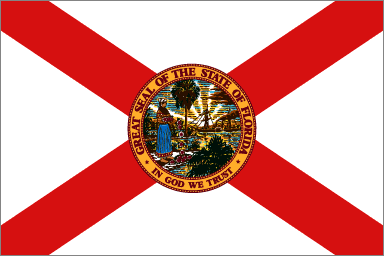
Modern Flag of the State of Florida
It is with the deepest gratitude to the many sources on the web that we can present the information that we have. We would like to specifically mention Florida State University, and the 2ndFlorida.com website.